

About the Journal
Building robust, ethical, and scalable organizations requires an integrated approach that recognizes the close interdependence between adaptive management strategies and data-driven business intelligence. As global markets and operational environments become increasingly volatile, it is essential to move beyond static models and embrace systems that prioritize reliability, transparency, and long-term strategic sustainability.
IJAMBI focuses on methods that are resilient to market uncertainty and distributional shifts, specifically designing systems that allow businesses and institutions to adapt to evolving real-world conditions. Achieving meaningful progress in this field demands attention to foundational challenges such as data quality, predictive analytics, computational efficiency, and responsible deployment within corporate and governmental frameworks.
The International Journal of Adaptive Management and Business Intelligence (IJAMBI) provides a dedicated scholarly platform to advance these objectives. With a multidisciplinary focus, the journal brings together perspectives from management science, artificial intelligence, business analytics, and organizational theory to deepen understanding of how intelligent systems can be designed and applied to enhance human decision-making.
IJAMBI supports research that bridges the gap between theoretical frameworks and practical business applications, encouraging contributions that demonstrate both methodological rigor and real-world relevance. Through its editorial standards, the journal promotes reproducibility and ethical responsibility, recognizing the critical role that adaptive systems play in shaping resilient, competitive, and equitable futures.
Current Issue
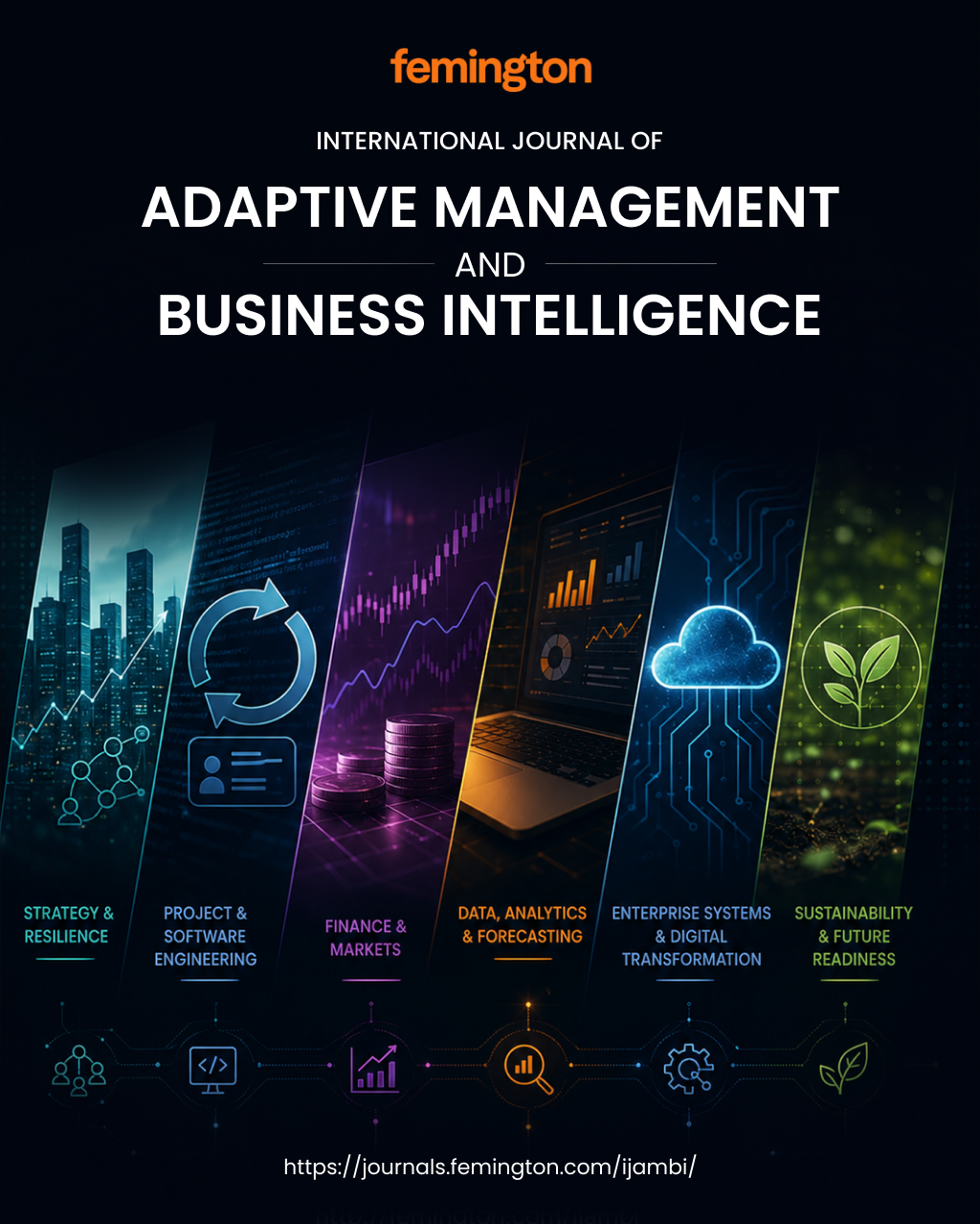
This issue presents a diverse collection of research advancing knowledge discovery, intelligent systems, and digital transformation across education, business, and enterprise technology. The featured studies explore learning analytics in virtual education, visual analytics for business workflows, organizational intelligence maturity, agile project integration, decentralized wireless infrastructure management, and university-based entrepreneurship. Further contributions examine generative AI for financial workflow automation, universal journal architecture in next-generation ERP, innovation in digital commerce, and deep neural attribution for stage-aware marketing. Together, these studies offer valuable insights into emerging technologies, strategic decision-making, and data-driven innovation.
Published: 2026-09-11