

About the Journal
ISSN: 3143-9977
Building robust, trustworthy, and autonomous artificial intelligence systems requires an integrated approach that recognizes the close interdependence between AI models, intelligent agents, computational infrastructure, human oversight, and real-world deployment environments. Advances in artificial intelligence, deep learning, generative AI, large language models, and agentic systems are increasingly transforming science, industry, governance, and society, making it essential to address not only model performance and autonomy but also safety, transparency, reliability, and long-term societal impact. This includes developing AI systems that can reason, learn, collaborate, and adapt under dynamic conditions while remaining aligned with human values, operational constraints, and ethical principles.
Achieving meaningful progress in artificial intelligence and autonomous systems demands attention to foundational challenges such as model robustness, explainability, generalization, alignment, computational efficiency, and responsible deployment. Equally important are broader considerations involving AI governance, safety evaluation, accountability, human-AI collaboration, access to computational resources, and the societal implications of increasingly capable intelligent systems. Addressing these challenges requires interdisciplinary collaboration that combines advances in AI theory, algorithms, architectures, and agent design with rigorous empirical validation and real-world applications.
The International Journal of Artificial Intelligence and Agent Systems (IJAIAS) provides a dedicated scholarly platform to advance these objectives. With a multidisciplinary focus, the journal brings together perspectives from artificial intelligence, deep learning, generative AI, foundation models, large language models, natural language processing, computer vision, reinforcement learning, agentic systems, multi-agent systems, autonomous systems, and trustworthy AI to deepen understanding of how intelligent and autonomous systems can be designed, evaluated, governed, and deployed responsibly. IJAIAS supports research that bridges foundational innovation and practical implementation, encouraging contributions that demonstrate both scientific rigor and real-world impact.
Through its editorial standards and publishing practices, IJAIAS actively promotes reproducibility, transparency, ethical responsibility, and rigorous peer review. The journal also seeks to contribute to broader global priorities by supporting research aligned with responsible AI development, digital transformation, human-centered innovation, AI safety, and trustworthy autonomous systems, recognizing the increasingly significant role that artificial intelligence and agent-based technologies play in shaping resilient, sustainable, and equitable futures.
Current Issue
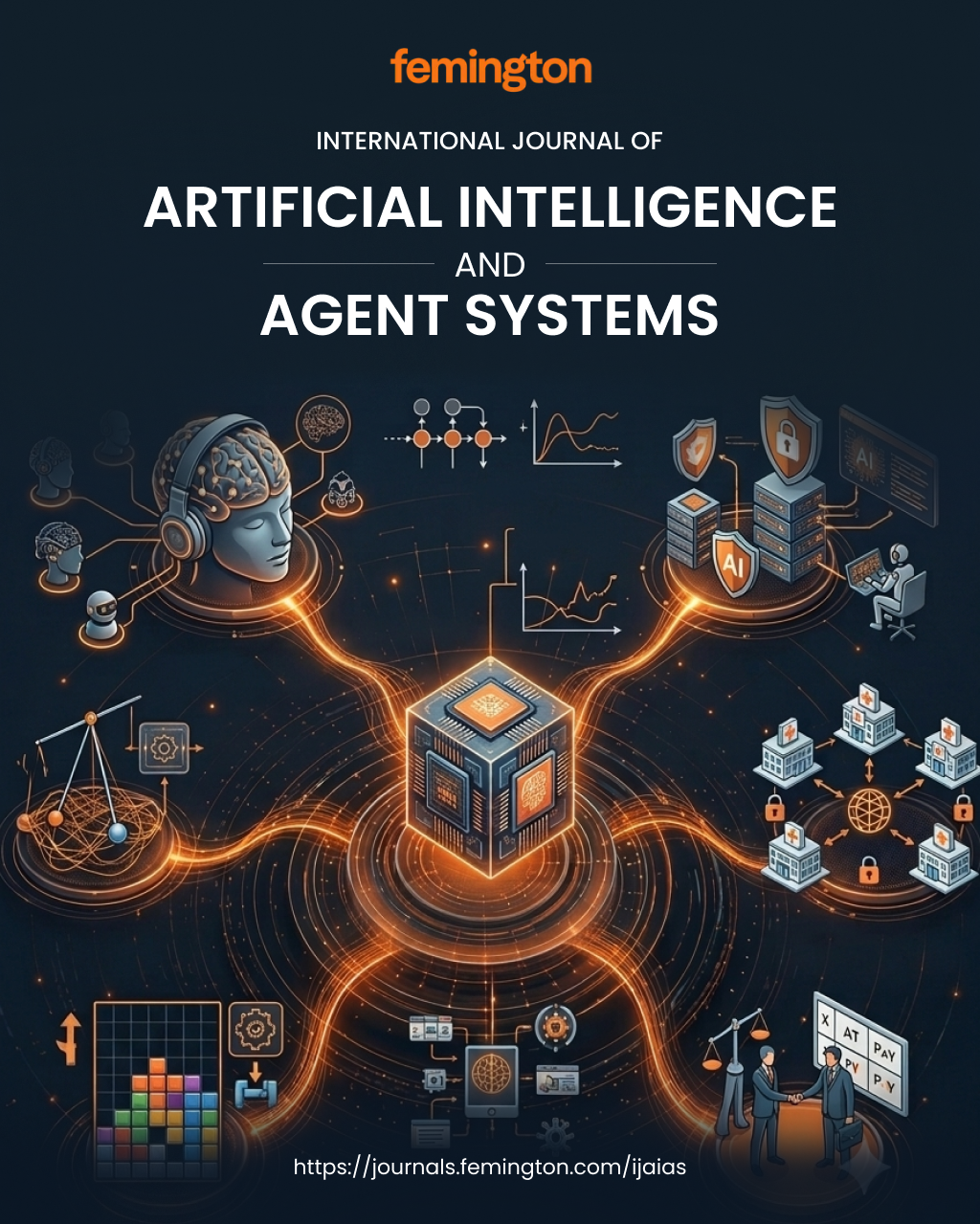
This issue presents a collection of contemporary research advancing the frontiers of artificial intelligence, machine learning, cybersecurity, healthcare informatics, and intelligent computational systems. The research addresses trustworthy and responsible AI for neurological disease detection, transformer-based EEG signal enhancement, AI-driven cybersecurity and digital forensics, privacy-preserving federated healthcare, model-free control, evolutionary intelligence, and game-theoretic learning. Further studies examine computational structure optimization, neural sequence modeling, reliability in retrieval-augmented generation agents, and multi-agent approaches to enterprise knowledge retrieval. Collectively, this issue highlights emerging methodologies that promote intelligent, secure, reliable, and practically applicable computational solutions across diverse domains.
Published: 2026-09-18